Welcome to Here for Vanity - sharing all things self-care, anti-aging, and beauty for navigating the glow-up after 40.
Glad you're here!
Learn more
A summer-to-fall reset I use when my skin suddenly feels dry, tight, irritated or dull.
By the time fall rolls around, I can usually feel the change in my skin before I notice it outside.
The lightweight moisturizer that was perfectly fine in August suddenly is not quite enough. My skin feels tighter after cleansing and I just notice my skin looking a bit duller than before.
This post may contain affiliate links. This means I may earn a small commission if you purchase a product through my link at no extra cost to you. All items are carefully curated by me and reflect my honest opinion.
I don’t overhaul my routine. Most of the time, I keep the products that are still working and make a few targeted changes to ensure I’m getting the right level of mostue and balance in my skin.
After 40, our skin naturally tends to become drier. Add cooler air, lower humidity, indoor heating, and hotter showers, and it makes sense that a summer routine might stop working as well.
Not necessarily.
If your skincare routine is working for you, keep it. No need to change.
You may benefit from making a few fall adjustments if you notice:
Lower humidity can make it easier for water to evaporate from the surface of the skin. Indoor heating, cold air, wind, and long hot showers can add to the problem. The American Academy of Dermatology also notes that skin tends to become drier as we age, making moisturizer increasingly important in our 40s and 50s.
This is why a seasonal change that barely registered in your 20s may be much more obvious after 40.
Related: The Complete Skincare Guide for Women Over 40

Here are the best fall skincare tips to help transition your skin into the cooler months. These have always helped my skin stay healthy, hydrated, and glowing, even as the weather changes.
This fall, switch to an oil-based makeup remover instead of a water-based one.
If you’re still using makeup wipes, it’s time to ditch them and use a hydrating oil cleanser like the D.H.C. Deep Cleansing Oil instead.
It melts away makeup while giving your skin the moisture it needs.
My pick for removing makeup and sunscreen:
Save: Neutrogena Ultra-Light Cleansing Oil
Splurge: D.H.C. Deep Cleansing Oil
Opt for a gentle cleanser as the weather cools down.
That squeaky-clean feeling is not proof that your cleanser did an excellent job. Especially after 40, it can be a sign that your cleanser removed more oil than your skin wanted to give up.
If your face feels tight immediately after washing, try a mild cream or low-lather cleanser. It should remove dirt and residual makeup without making you feel as though you need to sprint toward your moisturizer.
Unlike foaming cleansers that can strip your skin, cream-based cleansers cleanse without leaving it feeling tight or dry.
It’s a simple switch that helps maintain your skin’s moisture balance and doesn’t strip the skin.
My pick for a gentle daily cleanser:
Save: La Roche-Posay Toleriane Hydrating Gentle Face Cleanser
Splurge: iS Clinical Cream Cleanser
Exfoliating too often can lead to flaky, irritated skin, especially in the fall and winter when your skin is more sensitive.
Exfoliation is key for removing dead skin cells, but it should be limited to 1-2 times a week to avoid irritation and moisture loss.
I still exfoliate during fall, but I pay more attention to how my skin responds. If my usual schedule is working, I keep it. If I notice redness, burning, unusual tightness, or persistent peeling, I back off.
One or two exfoliating nights per week may be enough during cooler months, but there is no perfect schedule that applies to everyone. Product strength, skin type, retinol use, and your general tolerance all matter.
Try a gentle chemical exfoliant to keep your skin smooth and glowing without overdoing it. Alpha hydroxy acids (AHAs) are perfect for gently exfoliating your skin, revealing a brighter and smoother complexion.
My picks for gentle exfoliators:
Save: The Ordinary Glycolic Acid 7% Exfoliating Toner
Splurge: Sanitas Skincare GlycoSolution 5%
A hydrating serum is helpful when my skin feels dehydrated underneath my moisturizer, but it is not a replacement for moisturizer.
Hyaluronic acid is a humectant, so it helps attract and hold water at the skin’s surface. It still needs something over it to help slow down moisture loss.
I apply my hydrating serum to slightly damp skin and follow with moisturizer before my face completely dries.
The order looks like this:
I have used SkinMedica HA5 Rejuvenating Hydrator for years, and it continues to work well as my skin becomes drier with age.
It is expensive, and I would not tell everyone they need it. If your moisturizer already keeps your skin comfortable, you may not need a separate hydration serum. If your skin still feels tight underneath your moisturizer, this is where HA5 can make a noticeable difference.
My favorite hydrators:
Save: e.l.f. SKIN Holy Hydration! Triple Bounce Serum
Splurge: SkinMedica HA5 Rejuvenating Hydrator
Related: The Ultimate Skincare Essentials List For Women Over 40
If I were going to make only one seasonal change, this would probably be it.
A richer moisturizer is often more useful than adding several hydrating serums and hoping they somehow add up to a cream.
Look for formulas with a mix of ingredients that attract water, soften the skin, and reduce moisture loss. Glycerin, hyaluronic acid, ceramides, squalane, fatty acids, dimethicone, and petrolatum are all ingredients you may see in products made for dry skin.
I do not always switch directly from a lightweight summer moisturizer to a heavy cream. Sometimes I mix a small amount of the richer formula into my usual moisturizer and adjust the amount based on how my skin feels.
This is also a good way to avoid going too rich too quickly and ending up with clogged pores or breakouts.
My go-to fall moisturizers:
Save: LANEIGE Water Bank Blue Hyaluronic Moisturizer
Splurge: SENTÉ Dermal Repair Cream
I know it is cooler, cloudy, and possibly raining, but just because summer is over doesn’t mean UV rays go away.
Sunscreen stays in my routine all year. I use SPF 30 or higher on my face, neck, chest, and any other exposed skin. I also apply it to the backs of my hands, an area that gets far more incidental sun exposure than most of us realize.
This is also super important if you use retinol, exfoliating acids, vitamin C, or treatments for pigmentation. There is not much sense in working on dark spots at night while being inconsistent with sun protection during the day.
My top picks for sunscreens:
Save: Neutrogena Ultra Sheer Moisturizing Face Serum with Vitamin E & SPF 60
Splurge: Total Protection Face Shield Flex SPF 50
This is the advice I like the least because I love a long, hot shower when it is cold outside.
Unfortunately, very hot water can leave dry skin feeling even tighter and more irritated. I try to keep the water warm rather than extremely hot, shorten the shower when I can, and apply body moisturizer before my skin is completely dry.
To keep things cozy without compromising my skin, I take a quick warm shower and then wrap up in a heated robe straight from the towel warmer or dryer.
My exact towel warmer I use to keep things cozy while avoiding hot showers.
Why didn’t I try this sooner?
A humidifier is not an exciting skincare purchase, but I notice the difference when the heat comes on and the air inside my house gets dry.
I prefer running one in the bedroom because I spend several uninterrupted hours there. It can be particularly helpful if you wake up with dry skin, chapped lips, or that generally parched feeling.
The unglamorous but necessary part is keeping it clean. Follow the manufacturer’s instructions and change the water regularly. Otherwise, the helpful little skincare appliance beside your bed can become fairly disgusting.
Try this inexpensive humidifier to increase humidity when the air is drier.
I generally prefer a rich body cream to straight oil. Oil alone can feel as if it is sitting on top of my skin without giving me quite enough moisture.
When my arms or legs are particularly dry, I mix a few drops of body oil into my moisturizer and apply the mixture while my skin is still slightly damp.
This gives me the softness of an oil with the hydration and easier application of a cream. I pay extra attention to my shins, elbows, hands, and anywhere else that starts looking dry as soon as the temperature drops.
Favorite body oils:
Save: NOW Foods Sweet Almond Oil
Splurge: Augustinus Bader The Body Oil
Aquaphor is not glamorous, but it is one of those products I always come back to.
It is an occlusive ointment, which means it creates a protective layer that helps reduce moisture loss. I apply a thin amount over moisturizer on dry areas around my nose, mouth, or anywhere my skin needs more protection.
You do not have to cover your entire face. If you are acne-prone, dislike heavy products, or simply do not want to sleep with a shiny layer over everything, use it only where you need it.
It also works well on chapped lips, dry hands, cuticles, and elbows.
Top healing ointments:
Save: Aquaphor Healing Ointment
Splurge: iS CLINICAL Sheald Recovery Balm
My lips are usually one of the first places I notice the weather changing.
The worst thing I can do is peel at the dry skin or go after it with an aggressive scrub. If there is loose skin, I gently wipe my lips with a damp washcloth and immediately apply a thick lip treatment.
Aquaphor is perfectly effective if you want something simple. I also like Revision YouthFull Lip Replenisher and the Laneige Lip Sleeping Mask when I want a dedicated overnight product.
Try these for super-soft lips:
Save: e.l.f. SKIN Holy Hydration! Lip Mask
Splurge: Revision Skincare® YouthFull Lip Replenisher
Red light therapy is not a fall-specific treatment, but I tend to become more consistent with indoor routines once summer ends.
Red and near-infrared light devices are generally used to support smoother-looking skin, reduce visible inflammation, and improve signs of aging over time. The results depend on the quality of the device, its wavelengths and power, and whether you actually use it consistently.
What it does not do is replace moisturizer or immediately fix dehydrated skin. I consider it an optional long-term treatment, not a seasonal hydration solution.
Here’s a good Red Light Mask to keep skin glowing.
Drinking enough water is important. Drinking an enormous amount of water is not going to moisturize your face from within while you continue using a harsh cleanser and no moisturizer.
I focus on staying normally hydrated and eating enough protein, healthy fats, fruits, and vegetables. Salmon, walnuts, berries, eggs, citrus fruit, leafy greens, and olive oil all provide nutrients involved in normal skin structure and repair.
Electrolytes can be useful after a sweaty workout, illness, or another situation in which you have lost a meaningful amount of fluid. I would not take them specifically because my skin feels dry in October.
Collagen supplements and bone broth can contribute protein or collagen peptides to your diet, but I think of them as optional additions rather than a direct solution for seasonal dryness. Your topical routine is still going to do most of the immediate work here.
Related: The 12 Most Powerful Anti-Aging Superfoods for Women Over 40
After making these adjustments, this is the general order I follow.
I do not use every optional product every night. If my skin is irritated, I pare down my routine and keep it simple instead of adding more.
The best skincare products and other items to guarantee a hydrated, radiant complexion. Click here to see the curated fall skincare list on Amazon.
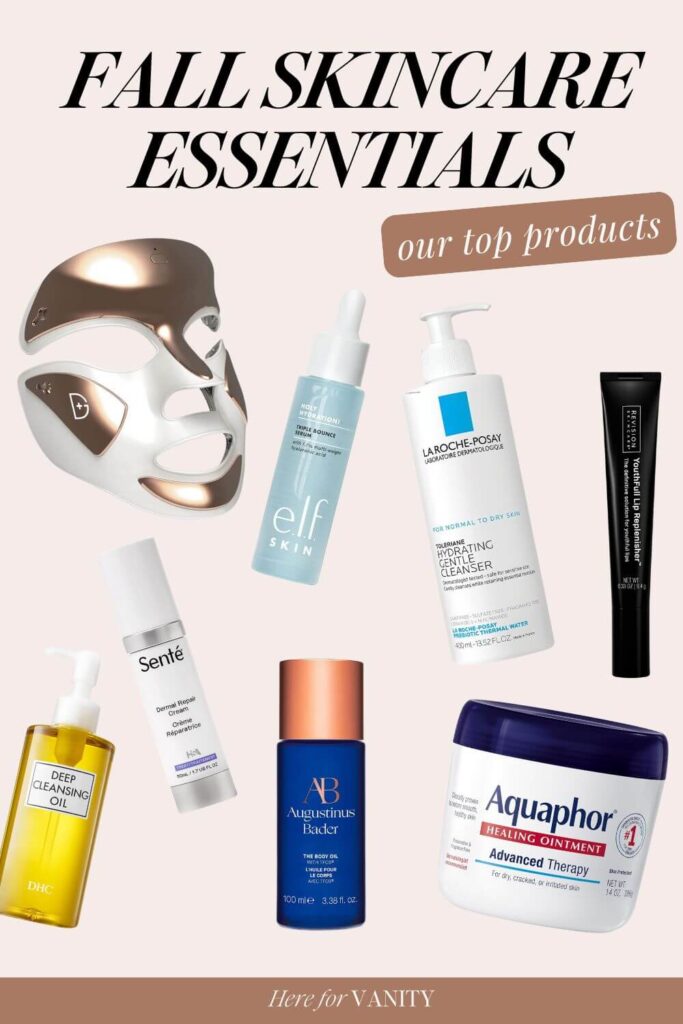
As we transition from summer to fall, updating your skincare routine can make all the difference in dry weather.
Try out these fall skincare tips, and let me know in the comments which one you’re excited to add to your skincare regimen! Don’t forget to share your favorite fall skincare must-haves, too—I’d love to hear what’s working for you!
Save these tips and visit Here for Vanity on Pinterest for more skincare advice over 40.