
Welcome to Here for Vanity - sharing all things self-care, anti-aging, and beauty for navigating the glow-up after 40.
Glad you're here!
Learn more
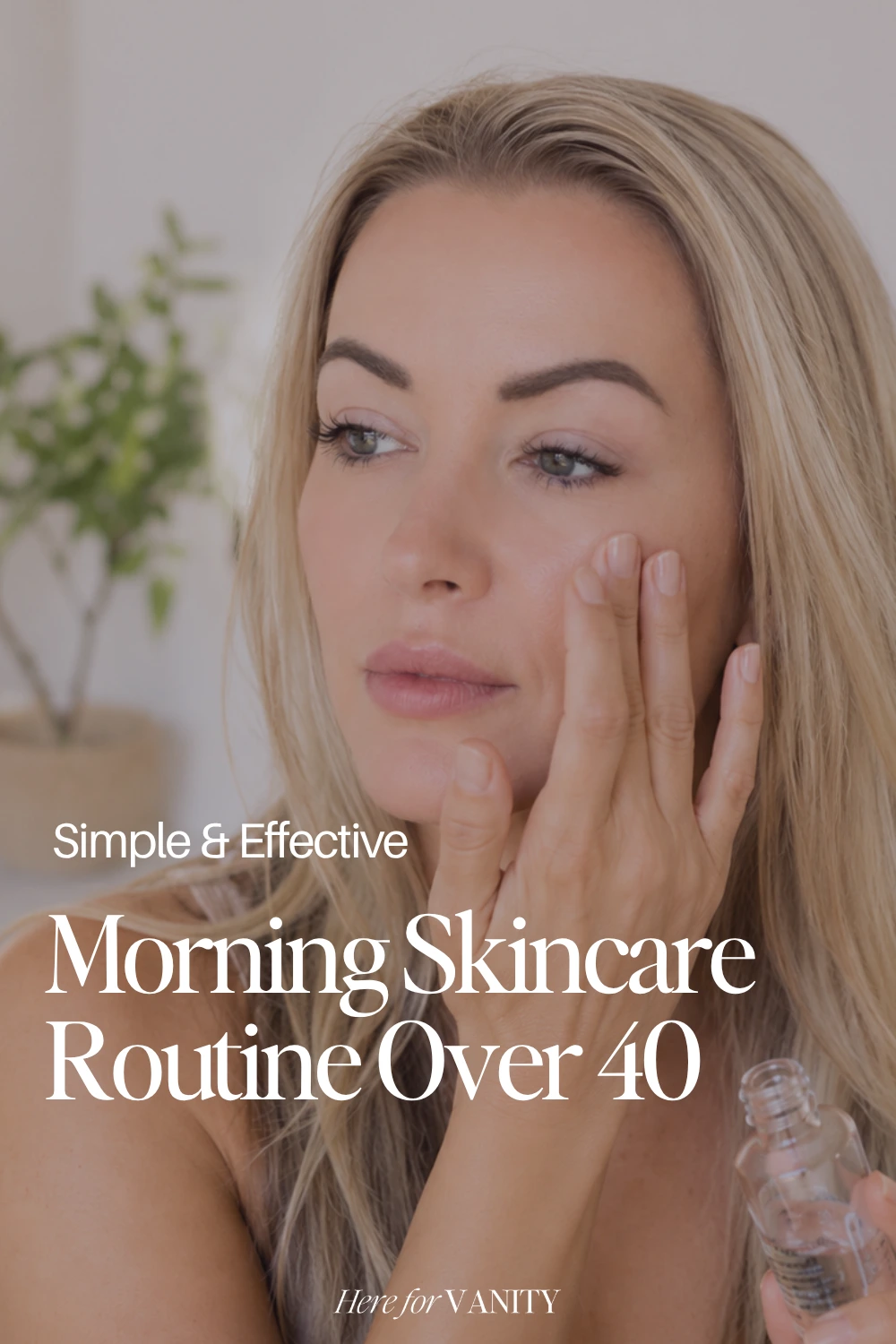
Here’s my super-simple morning skincare routine over 40 that actually works and is easy to stay consistent with.
After turning 40, I realized that simpler was better with skincare, especially in the morning. I moved away from 10-step skincare routines and started focusing on the products and routine that actually worked for my aging skin.
When I had too many steps, I realized I wasn’t as consistent and therefore didn’t see as good of results. When I simplified it and stuck with it, my skin was bouncy, hydrated, and glowing.
The Skincare Essentials guide covers every key ingredient for skin over 40 and the specific products worth using at each step.
This post may contain affiliate links. This means I may earn a small commission if you purchase a product through my link at no extra cost to you. All items are carefully curated by me and reflect my honest opinion.
Estrogen starts declining in the late 30s, which affects collagen production, cell turnover, and how well skin actually holds onto moisture, so the moisturizer that felt like plenty at 32 just doesn’t work as well anymore.
Yay. It’s okay though, we have options, and I’ve been pretty proud personally that I still get compliments on my skin even though the aging is definitely setting in.
With that, I’ve tried different products, spent way too much money, and then finally found what worked. Building a consistent daily skin care routine around what my skin needed at this stage is what actually moved the needle, not switching to more expensive products.
I probably wasted a good amount of money layering products in the wrong sequence before I understood that the order actually matters.
Apply products out of sequence and your most effective serum absorbs almost nothing because the moisture barrier you built before it is blocking the way, so the rule is thinnest to thickest with actives before moisture and SPF always last.
I think simpler is best, really. You don’t need much. I still spend way too much on skincare because I truly love it, but you don’t need to.
For a long time my morning cleanser was way too stripping without me realizing it, because I was using the same one I’d had for years and it was formulated for oilier skin than I actually had at 43.
A cream or gel formula works for most skin types in the 40s, and if your face feels tight after washing, that’s the cleanser working against you rather than for you.
Often times I skip the cleanser in the morning entirely and just rinse with water, which is worth trying if your skin is drier. My favorite cleanser right now is the Elemis facial cleanser.
I swear by a good Vitamin C serum and it belongs in the morning routine for most skin types.
Vitamin C is an antioxidant that protects against environmental damage and free radicals, supports collagen production, brightens overall skin tone, and targets the hyperpigmentation that gets a lot harder to shift after 40, and research backs up all of it.
The one thing worth knowing is that L-ascorbic acid, the most active and well-studied form, needs a concentration between 10 and 20 percent to actually do the work, so check the label before you buy.
Apply it to slightly damp skin right after cleansing and give it about 60 seconds before layering anything on top. If your skin is on the more sensitive side, start with a lower concentration and work up, since higher percentages can cause some initial redness or tingling until your skin adjusts.
Eye cream isn’t necessarily a must but I always like one with SPF for added protection. My holy grail is this one by ColorScience, it’s a bit pricey but also doubles as a corrector.
The eye area is the thinnest area on your face and tends to dry out a little faster as you age. A nice moisturizer is another option if you don’t want to buy another product. Sometimes I use my thicker nighttime creams on my eyes and it works well.
A good moisturizer is a must-have. It seals everything underneath it, which is why applying it before your serum undoes most of what the serum was trying to do in the first place.
For a genuinely hydrating skincare routine over 40, ceramides or peptides in the formula do more than a standard lightweight lotion because the barrier support is doing real work here, not just adding a layer of softness.
A moisturizer with SPF can combine steps four and five if the SPF is at least 30 and you’re applying enough of it, though most people apply about half of what’s needed for real protection.
Obviously, also a necessity. Even if my moisturizer has SPF, I like to give my face and neck another good layer. Sunscreen is important even on cloudy days.
UVA rays drive collagen breakdown and pigmentation and they come through windows and car windshields, so working from home doesn’t get you out of this one. The only real barrier to wearing it every day is finding a formula that doesn’t pill under makeup, and there are tons of good options these days.
Here are the ones I’m loving right now:
These are the ones I actually look for when I’m evaluating something new, based on what’s made a visible difference in my own morning skin care routine:
For the full ingredient breakdown and product recommendations for every step, the Skincare Essentials guide has everything in one place.
Retinol goes at night, and this is the mistake I see come up constantly when someone tells me their skin isn’t responding to their routine. It’s photosensitive, which means it degrades in sunlight and increases UV sensitivity, so applying it in the morning and adding SPF on top isn’t a fix for anything.
Exfoliating acids are the same story, because in a morning and evening skin care routine AHAs and BHAs go on at night and get followed by SPF the next morning. Morning handles protection and night handles repair, and splitting the work between them makes both routines more effective than loading everything into one.
Growth factors are another one I’ve moved to my nighttime routine. Technically they can go in the morning too, but the cellular repair signaling they do feels more aligned with what night is already for.
They’re different from peptides even though they often get grouped together: peptides signal your skin to produce specific proteins like collagen, while growth factors are working at the cellular level, telling your skin to regenerate the way it did when it was younger.
I’ve definitely noticed a difference in texture and firmness since adding them consistently. I use the SkinMedica TNS, it’s expensive but I haven’t found a good replacement yet. If you have one, let me know!
Cleanser, brightening serum, eye cream, moisturizer, sunscreen, in that order, thinnest to thickest with actives before moisture barriers and SPF always last.
Yes, somewhat. The steps stay the same but go for creamier/heavier products. So a cream cleanser over gel, a hyaluronic acid step between serum and moisturizer applied to damp skin, and a richer moisturizer with ceramides will help dry skin feel hydrated.
No, because morning handles antioxidants and UV protection while night handles retinol, peptides, and deeper repair, and retinol in particular doesn’t belong in the morning routine for any reason.
Used consistently and early enough, it can help because it maintains hydration in an area that dries out faster than the rest of the face and works better as prevention than correction. However, a good moisturizer could work well too.
Yes if the SPF is at least 30 and you’re applying a full amount, though most people under-apply when it’s combined with moisturizer, which drops the effective protection significantly and makes a dedicated sunscreen the better call for extended time outside.
A morning skincare routine over 40 only works when it’s repeatable enough to actually do every day and not just on the mornings when you have time.
Five steps, the right sequence, products suited to where your skin is right now, and enough patience to let the routine actually work before deciding it isn’t.
Ready to build the full system? The Glow Protocol walks through what your skin needs at every phase, starting with the foundation that makes your morning routine actually land.


